Join us for our latest webinar in collaboration with Cboe

The Pressure of Dilution on Layer 1 Valuations

Ethereum

DeFi

Hyperliquid

Liquidity

Tokenization

02/03/2026

    Welcome to the Data Debrief!

    Welcome back to the Data Debrief! 

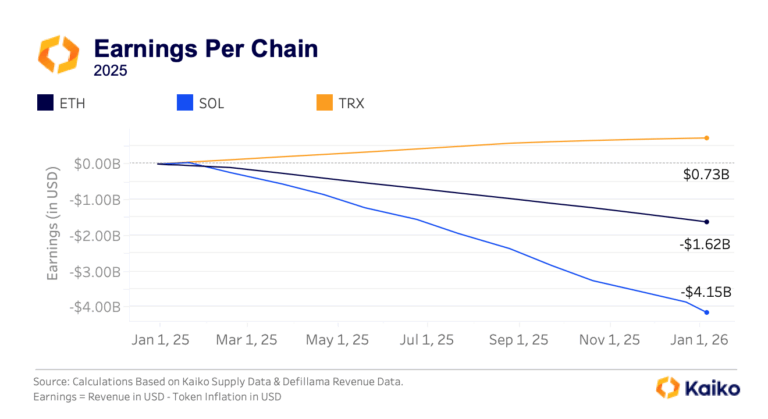
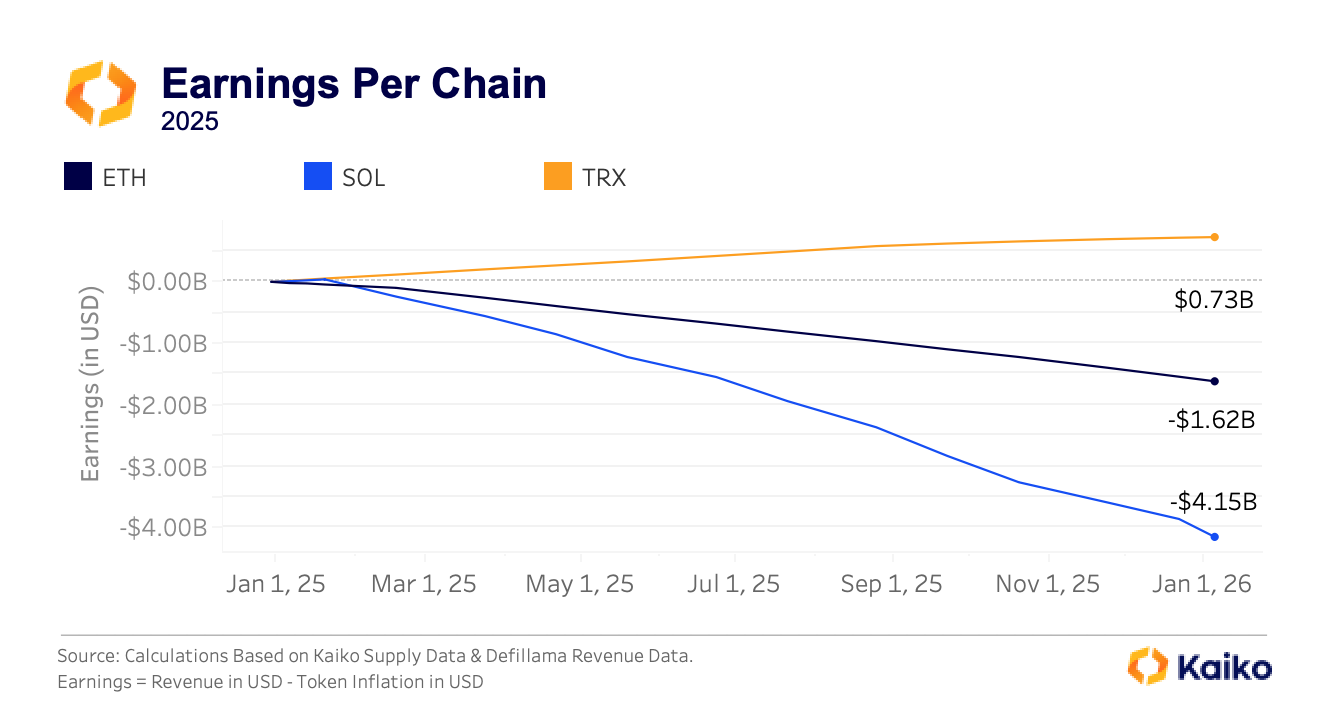
    As Layer 1 tokens are increasingly traded through ETFs and evaluated like equity investments, the market is discovering an uncomfortable truth, most major blockchains operate as loss-making businesses. With Ethereum posting $1.62B in annual losses and Solana bleeding $4.15B despite generating hundreds of millions in fee revenue, validator dilution costs consistently outpace income by 7-25x.
    • Ethereum’s post-Dencun revenue collapsed 98% from $25M to $1M daily as L2s shifted to blob fees

    • Tron shows a revenue floor that ETH and SOL lack, their fee income tracks utility rather than speculation

    • Hyperliquid proves revenue-based validator economics are achievable

    The Pressure of Dilution on Layer 1 Valuations

    As institutional access to cryptocurrency expands through ETFs and strengthened exchange regulation, market participants have focused increasingly on protocol revenue over the past year, yet most chains generating hundreds of millions in fees still lose money for token holders. Unlike traditional companies where earnings equal revenue minus operating expenses, blockchain protocols must account, for instance, for token dilution as a direct cost to holders. For most Layer 1s (L1s) in their current state, earnings equal annual revenue minus annual token dilution.

    When a protocol issues new tokens to validators or stakers, it dilutes existing holders even if fee revenue appears high. This dilution represents a real economic transfer from holders to validators, making it the primary cost in evaluating true profitability.

    Revenue for L1 protocols refers to the total value of fees collected by the protocol from network activity over a given period. This includes transaction fees paid by users to have their transactions included in blocks, comprising base fees and priority fees (tips).

    Annual token dilution is the total market value of new tokens issued by the protocol to validators, stakers, or other network participants over a one-year period. This represents block rewards and staking rewards created from new issuance, measured in dollar terms by multiplying the number of new tokens issued by the average token price.

    Looking at 2025 earnings data, Solana (SOL) recorded $4.15B in net losses while Ethereum (ETH) lost $1.62B. ETH posted $260M in revenue, SOL generated $170M in fees, and Tron (TRX) brought in $732M. However, only Tron’s revenue exceeded its dilution costs, achieving positive earnings and net token deflation.

    This exposes an uncomfortable reality the market has largely ignored, most major blockchains operate as loss-making businesses for token holders, with only one traditional L1 achieving sustained profitability. While these protocols were never designed to run as traditional businesses, this matters increasingly for the investors, institutions, and retail traders who now hold these tokens. As L1 tokens are increasingly traded and analyzed as growth stocks, particularly following the approval of multiple ETFs, they should be evaluated using the same profitability metrics applied to equity investments.

    Want the full analysis?

    Subscribe to Kaiko Research Premium for more market insights.

    Get the full analysis

    Data Used In This Analysis

    Our industry-leading research is the direct result of combining our proprietary data with world-class in-house experts. Bringing the very best of Kaiko’s people and data together, we unlock the unique insights that form the basis for our discoveries and analysis. We believe in doing so, our data speaks for itself, helping both our clients and the wider industry get a better understanding of the crypto ecosystem, and the evolving trends and patterns in motion at a regional and global scale.

    • Market Explorer

      Price and transaction volume for centralized and decentralized exchanges.

    • Level 1 & Level 2 Market Data

      Tick and aggregated market data, from cryptocurrency exchanges.

    • Blockchain Monitoring Tool

      All users, all transactions, and all history for blockchain wallets.

    More From Kaiko Research

    • Hyperliquid

      09/03/2026 Data Debrief

      Bitcoin Ranges While Traditional Assets Find New Home on Crypto Rails

      As Bitcoin ranges between $60k and $72k following the early February sell-off, the crypto market navigates competing forces, with geopolitical shocks testing 24/7 infrastructure and options markets pricing elevated volatility into the Federal Reserve’s March 18th decision.

    • Ethereum

      02/03/2026 Data Debrief

      The Pressure of Dilution on Layer 1 Valuations

      As Layer 1 tokens are increasingly traded through ETFs and evaluated like equity investments, the market is discovering an uncomfortable truth, most major blockchains operate as loss-making businesses. With Ethereum posting $1.62B in annual losses and Solana bleeding $4.15B despite generating hundreds of millions in fee revenue, validator dilution costs consistently outpace income by 7-25x.

    • Ethereum

      23/02/2026 Data Debrief

      Staking Products Launch Despite Treasury Failures

      As crypto volatility continues, the markets are testing whether institutional ETH adoption follows price or infrastructure development. With ETH plunging 50% from its mid-2025 peaks to $2,000, this triggered a 95%+ collapse in equity treasury vehicles like ETHZilla and $4B in spot ETF outflows.

    • Prediction Markets

      16/02/2026 Data Debrief

      Prediction Markets Liquidity In Focus

      Prediction markets captured mainstream attention throughout 2025 as Polymarket processed over $2 billion in election-related volume. The post-election collapse from $1 billion to $200 million in open interest exposed fundamental questions about sustainability.